 592781212
 Login
Login Register




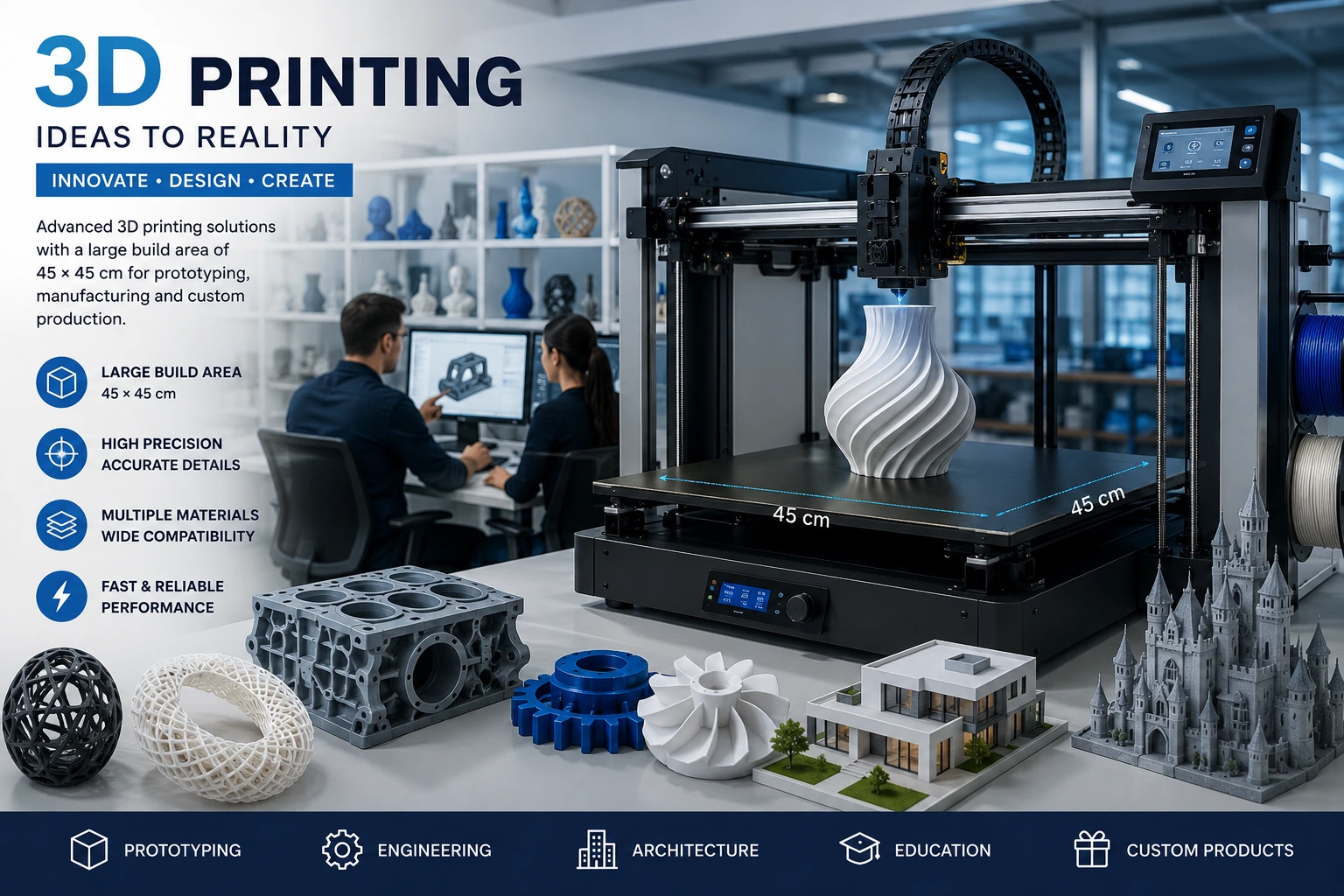
What Is 3D Printing? Complete Guide, Process, and Benefits
3D Printing Workflow — Advanced Manufacturing Technology with a 45 × 45 cm Build Area
What Is 3D Printing?
3D printing is an innovative manufacturing technology that transforms digital designs into physical objects. The process works by building an object layer by layer, allowing the creation of complex geometries, prototypes, decorative items, and functional components with exceptional precision.
This 3D printing production line features a 45 × 45 cm build area, making it suitable for both small-scale projects and large-format 3D printed products.
A. 3D Model Creation
The process begins with creating a digital 3D model.
Commonly used software includes:
-
Blender
-
Fusion 360
-
SolidWorks
-
AutoCAD
-
SketchUp
-
Tinkercad
At this stage, designers create:
-
3D models
-
Product prototypes
-
Technical components
-
Decorative objects
-
Functional parts
B. Print Preparation
The completed model is imported into slicing software.
During this stage, the following parameters are configured:
-
Model dimensions
-
Layer height
-
Infill density
-
Support structures
-
Printing time estimation
-
G-Code generation
Proper print preparation ensures optimal print quality and efficiency.
C. Material Selection
A variety of filament materials can be used depending on the application.
Popular materials include:
-
PLA
-
PETG
-
ABS
-
TPU (Flexible Material)
-
Nylon
-
Carbon Fiber Filament
The material is selected according to the required strength, flexibility, durability, and appearance of the final product.
D. Printer Setup
Before printing begins, the machine is prepared and calibrated.
This includes:
-
Bed leveling and calibration
-
Filament loading
-
Nozzle inspection
-
Temperature adjustment
-
Print parameter verification
Proper setup is essential for achieving consistent and accurate results.
E. 3D Printing Process
The printer builds the object layer by layer according to the digital model.
Key advantages of the process include:
-
High precision
-
Complex geometry creation
-
Minimal material waste
-
Rapid prototyping
-
Design flexibility
The large 45 × 45 cm build area allows the production of oversized models and large functional components without splitting them into smaller parts.
F. Post-Processing and Finishing
After printing, additional finishing operations may be performed.
These include:
-
Support removal
-
Surface sanding
-
Painting
-
Coating
-
Polishing
-
Assembly
These steps enhance both the appearance and functionality of the final product.
G. Quality Control
Each printed item undergoes a detailed inspection.
Quality checks include:
-
Dimensional accuracy
-
Layer consistency
-
Surface quality
-
Structural integrity
-
Functional performance
This stage ensures that every product meets design specifications and customer expectations.
H. Packaging and Delivery
After inspection and finishing, the products are carefully packaged and prepared for delivery.
Applications of 3D Printing
3D printing is widely used for producing:
-
Product prototypes
-
Architectural models
-
Engineering components
-
Decorative items
-
Customized products
-
Educational models
-
Medical models
-
Spare parts
-
Promotional products
-
Industrial tooling
Advantages of a 45 × 45 cm 3D Printing System
✔ Large 45 × 45 cm build area
✔ High precision and accuracy
✔ Rapid prototyping capabilities
✔ Ability to create complex geometries
✔ Minimal material waste
✔ Wide range of compatible materials
✔ Suitable for small and large production runs
✔ Excellent customization possibilities
Conclusion
A 3D printing production line equipped with a 45 × 45 cm build area provides a powerful and flexible solution for modern manufacturing. Its ability to quickly transform digital concepts into physical products makes it an essential tool for designers, engineers, architects, educators, and businesses seeking innovative production methods. With high precision, material versatility, and extensive customization options, 3D printing continues to revolutionize the future of manufacturing and product development.

