 592781212
 Login
Login Register




_1722152045.png)
UV Printing: The Technology That Transformed the Advertising Industry
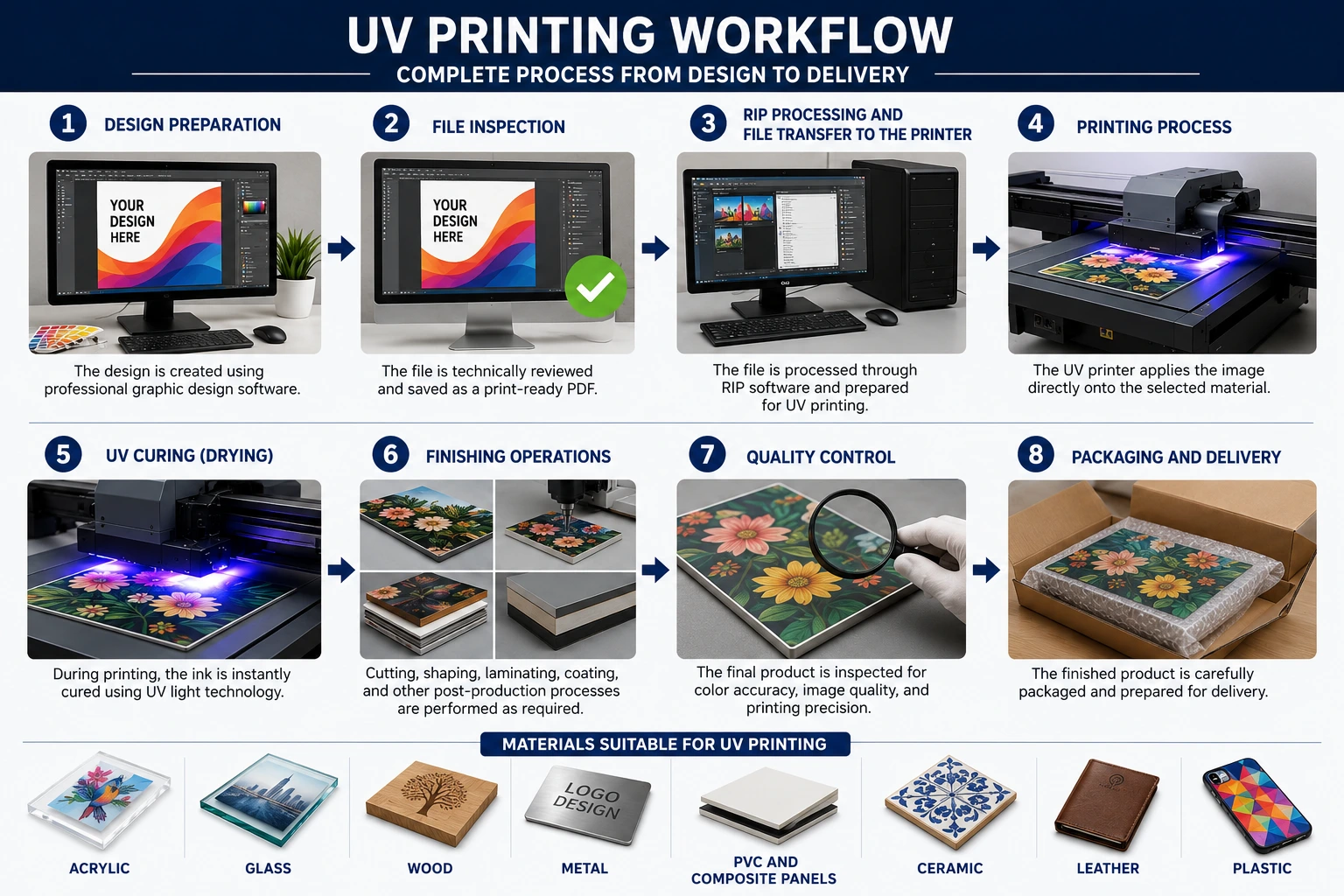
UV Printing Workflow — Complete Guide from A to Z
What Is UV Printing?
UV printing is an advanced digital printing technology that uses ultraviolet (UV) light to instantly cure and harden specially formulated inks during the printing process. Unlike conventional printing methods, UV inks dry immediately upon exposure to UV lamps, allowing direct printing on a wide variety of materials.
UV printing is widely used for promotional products, signage, packaging, industrial marking, interior decoration, and personalized merchandise.
A. Design Preparation
The process begins with creating or preparing the artwork using professional graphic design software such as Adobe Illustrator, Photoshop, CorelDRAW, or similar programs.
Important considerations include:
-
CMYK color mode
-
High-resolution graphics
-
Correct dimensions
-
Bleed and safety margins
-
Transparent backgrounds when required
B. File Inspection and Prepress Setup
Before production, the design file is carefully checked to ensure print readiness.
This stage includes:
-
Font verification
-
Resolution checking
-
Color profile adjustment
-
White ink layer preparation (if needed)
-
Varnish layer preparation (optional)
-
Exporting a print-ready file
C. Material Selection and Preparation
One of the biggest advantages of UV printing is its ability to print directly on numerous substrates.
Common materials include:
-
Acrylic
-
Glass
-
Wood
-
PVC
-
Metal
-
Leather
-
Plastic
-
Cardboard
-
Foam board
-
Promotional products
Before printing, the material surface is cleaned and positioned on the printer bed.
D. Printer Setup and RIP Processing
The approved artwork is processed through RIP software.
The RIP system:
-
Converts artwork into printable data
-
Controls color management
-
Generates white ink layers
-
Creates varnish effects if required
-
Optimizes print quality settings
E. UV Printing Process
The UV printer deposits ink directly onto the substrate.
Immediately after the ink is applied, UV lamps expose the ink to ultraviolet light, causing it to cure instantly.
Benefits include:
-
Sharp image quality
-
Vibrant colors
-
Excellent adhesion
-
High durability
-
Scratch resistance
F. UV Curing and Surface Finishing
Unlike traditional printing methods, UV printing does not require extended drying time.
The curing process occurs instantly during printing, creating:
-
Durable prints
-
Water-resistant surfaces
-
Fade-resistant graphics
-
Chemical-resistant finishes
Optional finishing may include:
-
Gloss varnish
-
Matte varnish
-
Spot UV effects
-
Protective coatings
G. Quality Control
Each printed item undergoes inspection to ensure quality standards.
Quality checks typically include:
-
Color consistency
-
Image sharpness
-
Ink adhesion
-
Surface finish quality
-
Dimensional accuracy
-
Material integrity
H. Packaging and Delivery
After final inspection, products are packaged and prepared for shipment or installation.
Common UV printed products include:
-
Promotional gifts
-
Phone cases
-
Pens
-
Keychains
-
Signage
-
Acrylic displays
-
Awards and trophies
-
Packaging prototypes
-
Industrial labels
-
Interior decorative panels
Advantages of UV Printing
✔ Instant curing and drying
✔ High durability and scratch resistance
✔ Excellent color reproduction
✔ Direct printing on rigid and flexible materials
✔ Water and chemical resistance
✔ Eco-friendly printing process
✔ Suitable for both small and large production runs
Conclusion
UV printing has revolutionized modern print production by enabling direct-to-surface printing with exceptional durability and image quality. Its ability to print on diverse materials, combined with instant curing technology, makes UV printing one of the most versatile and efficient solutions for commercial, industrial, and promotional applications.

